Chords for How to play 'St. Thomas' by Sonny Rollins on the piano -- Playground Sessions
Tempo:
127.35 bpm
Chords used:
C
E
G
D
Em
Tuning:Standard Tuning (EADGBE)Capo:+0fret
Jam Along & Learn...
Hey guys, welcome back to Playground Sessions' [Em] YouTube channel.
Phil, [G] and today I'm gonna
by Sonny [E] Rollins [G] called St.
be looking [F] at
arrangement, and that
One, [C] two, set, go.
[Em] [C]
[Am] [D] [G] [C]
Phil, [G] and today I'm gonna
by Sonny [E] Rollins [G] called St.
be looking [F] at
arrangement, and that
One, [C] two, set, go.
[Em] [C]
[Am] [D] [G] [C]
100% ➙ 127BPM
C
E
G
D
Em
C
E
G
Hey guys, welcome back to Playground Sessions' [Em] YouTube channel.
[A] I'm Phil, [G] and today I'm gonna
be showing you how to play [C] a jazz tune by Sonny [E] Rollins [G] called St.
Thomas.
[E] We'll be looking [F] at
the main theme from the [D] Playground Sessions intermediate level arrangement, and that
section we're gonna be learning today sounds [F#] like this.
One, [C] two, set, go. _ _ _
[Em] _ _ _ _ [C] _ _ _ _
_ [Am] _ _ _ [D] _ [G] _ _ [C] _
This is a fun,
[G] light, bouncy [D] jazz tune by one of the genre's greatest performers and composers, so I'm [C] excited
to be teaching you guys this one today.
And we're gonna do the right hand [A] melody first,
[C] then we're gonna look at the left hand chords, then we're gonna put [E] the hands together,
just like we do in all of these [D] YouTube lesson videos.
[C]
Speaking of lesson videos here on YouTube,
[G] we just [E] decided to start [E] posting three per [D] week instead of [D] two, so now you've got [F#] an additional
song [C] lesson per week, an additional genre, an additional [A] artist, [E] so there's more options [G] to
choose from.
Tap the card above to learn more about the three songs we're posting per week.
But let's go ahead and break this down, starting with the right hand first.
Let's [F] go.
First off,
our key [D] signature, zero sharps, zero flats.
That means we're in the key of C major,
[F#m] and the time signature [C] tells us four four, four beats per measure.
Hand position is pretty
straightforward.
We start with our two finger on G above middle C.
_ [Cm] Our five is on C above that,
_ [B] walking down four on [A] B, three on [G] A, two on G, [A] _ _ thumb down to [Em] E.
_ _ [C] _ _ _ _
This is our position from E to C. _
And within that position, the two and three fingers shift a bit, but we never extend or
change positions outside of this six note position, at least for this main section.
So let's talk rhythm.
The first measure, we are all syncopated eighth notes, all on the upbeats. _
One and two and [B] three and [E] four and.
All on the upbeats, resting on all the downbeats.
Then the
second measure, we're playing eighth notes still but we're all on downbeats this time.
So in measure
two, it goes one and two and three and [Fm] four and.
_ [C] So measure one, all syncopated.
Measure two,
all on the strong beats.
And that sounds like this.
One and two and three [E] and [E] four and one
and two and three [Fm] and four. _
[G] Measure three, also on strong beats.
_ One and [C] two [E] and three [C] and four
and.
[G#]
Then we have a measure of rest, and the second line below is almost exactly the same
except for one little rhythm there in the second measure of that second line.
[Em] Instead of one [A] and
two and three [F] and four and, [Gm]
we play one and [A] two and three [Fm] and four.
So it's [D] the same thing,
but instead of playing G [E]
rest, _ _ [D] we play G G. _
[F] _ Otherwise the same.
Why don't we bring up our
medium tempo backing track so we can play along with our jazz band, and let's practice this at
the learning tempo.
When we've got that down and we've done it a few times so we're feeling
comfortable, then we'll try it at full tempo.
But [E] here we go.
Medium tempo.
[C] One, two, set, [F#] go.
_ [C] _ _ _ [A] _ _ [E] _ _
[G] _ _ _ _ [C] Rest.
Now look ahead.
_ _ _ [Am] Two eighth notes [E] now. _
_ _ _ [C] _ _ So guys, [E] please rewind to play back with me at [D] that
medium tempo, but when you're ready, meet me here.
We're going to try it once [A] at full tempo.
[C] One,
two, [F] set, go.
[C] _ _ _ [E] _ _ [G] _ _
[C] _ _ _ _ [G] _ _ _ [E] _
_ [G] _ _ Great work!
Well, that's the right hand.
Now let's talk about the left [D] hand harmony.
Then we'll bring the right hand back in at the end to put the hands together.
Alright, [C] so we've
got a handful of chords in this left hand part.
Why don't we just walk through [Em] each [E] one [G] independently
of any [C] rhythms or timing or counting just so [A] we can get used to the [C] chord shapes.
[Cm] Then [D] as a second
step, we'll add some timing to it.
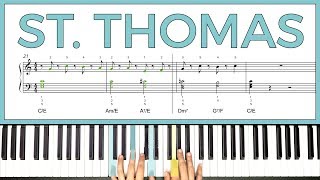
Our first chord is C [C] over E.
First inversion C major chord.
We're
playing that with five three one fingers, _ _ and we've got that for four counts, the whole measure.
Next measure, we change the middle note up to an A.
That [Am] gives us A minor over E.
_ _ _ Next chord, A seven
over E.
We're dropping the middle note back to G.
We're sliding our hand back [Em] up to the back of
the keys so our thumb can play C sharp.
_ _ _ _ _ Alright, those are each two counts.
Now measure three.
Still two count notes, [F] still a half note.
We're going to play D minor seven. _
We're going to do it
with five four one. _ _ _
Okay, next chord in this measure, G seven over [F] F.
Just these two notes,
F and B, four and one.
And then to finish out this first phrase, we're going to play the same
chord we did in the beginning, C [C] over E, [E] just for one quarter note, and then we're going to rest.
Second line down, exactly the same [C] thing.
So C over E, A [Am] minor over E, [Em] A seven over E, [F] D minor seven, _
[F] G seven over F, [C] C over E.
So [D] just like the right hand, let's try this at our [E] medium tempo now [F] first,
then we'll go to [F#] full tempo.
One, [C] two, [D#] set, go.
_ [C] _ _ _ _ _ [Em] _
_ [Dm] _ _ _ [G] _ _ [C] _ _
_ _ _ _ _ [Am] _ _ [Em] _
_ [Dm] _ _ _ [C] _ _ Alright, [E] now full tempo when you're ready.
[C] One,
two, set, go.
_ _ _ [Am] _ _ _ _
_ _ _ _ _ _ _ _
_ [G] _ _ [C] _ Alright, guys, all we've got to [G] do now is put these [Em] hands together, so let's [D] do that.
But first, let me just say, before we wrap up this video by putting the hands together,
[C] where do you go from here [E] once you're done?
You gotta learn the [E] rest of the song.
There's more
[G] sections.
There's a solo section in the advanced level arrangement, at least, and [G] there's multiple
[C] difficulty levels.
There's also a rookie level [G] arrangement.
[E] All of that can be found in the
Playground Sessions app, [D] and right now we're [C] doing a free trial where you can [E] try the app for [C] 30 days
with no strings attached.
So click the link in [G] this video description [E] or tap that card [G] above
to start your free trial today.
Alright, let's go ahead and try to put [E] these hands together.
I [G] encourage you first [C] to pause and go [E] through each [G] beat of each measure, [D] figuring out when the
hands play on the same beat or when, let's [F#m] say, the right hand plays while the [C] left hand is resting,
or [E] let's say the left hand plays while the right hand is holding out a different note.
I want you
to walk through each beat of each measure and figure that stuff out without the pressure of
any metronome [D] or tempo or counting.
Once you're feeling good there, then meet me back here.
We're
gonna try this hands [E] together at the medium tempo.
One, [C] two, [E] set, go.
_ [C] _ _
_ _ [Am] _ _ [Em] _ _ _ [G] _
_ [C] _ _ _ _ _ _ _
_ [Am] _ _ _ [D] _ _ _ [G] _
_ [C] _ _ _ [Em] There we go.
So as always,
[F] practice with that [D] speed as many times as you need.
Now we're about to wrap this up at full
[D] tempo.
Let's go for it.
One, [C] two, set, go.
_ _ [Am] _ _ _ _
_ [C] _ _ _ _ _ _ _
[Em] _ [D] _ _ _ [C] _ Alright, guys.
[G] Way to go today.
[D] You learned the
main section from the intermediate [D] level arrangement of [F#] classic jazz song [C] by Sonny
Rollins called St.
Thomas.
Give [A] yourselves a round of applause. _
[D] _ _ [C] _ _ [E] _ _ _
Features you saw on screen
today can be at your fingertips with [C#m] the Playground Sessions app.
[E] Co-created by music legend Quincy
Jones, Playground teaches the piano with interactive [C#m] feedback and gaming features,
[E] all while using your favorite songs.
Alright, guys.
I'm Phil.
Hit subscribe so I can see you
for the
[A] I'm Phil, [G] and today I'm gonna
be showing you how to play [C] a jazz tune by Sonny [E] Rollins [G] called St.
Thomas.
[E] We'll be looking [F] at
the main theme from the [D] Playground Sessions intermediate level arrangement, and that
section we're gonna be learning today sounds [F#] like this.
One, [C] two, set, go. _ _ _
[Em] _ _ _ _ [C] _ _ _ _
_ [Am] _ _ _ [D] _ [G] _ _ [C] _
This is a fun,
[G] light, bouncy [D] jazz tune by one of the genre's greatest performers and composers, so I'm [C] excited
to be teaching you guys this one today.
And we're gonna do the right hand [A] melody first,
[C] then we're gonna look at the left hand chords, then we're gonna put [E] the hands together,
just like we do in all of these [D] YouTube lesson videos.
[C]
Speaking of lesson videos here on YouTube,
[G] we just [E] decided to start [E] posting three per [D] week instead of [D] two, so now you've got [F#] an additional
song [C] lesson per week, an additional genre, an additional [A] artist, [E] so there's more options [G] to
choose from.
Tap the card above to learn more about the three songs we're posting per week.
But let's go ahead and break this down, starting with the right hand first.
Let's [F] go.
First off,
our key [D] signature, zero sharps, zero flats.
That means we're in the key of C major,
[F#m] and the time signature [C] tells us four four, four beats per measure.
Hand position is pretty
straightforward.
We start with our two finger on G above middle C.
_ [Cm] Our five is on C above that,
_ [B] walking down four on [A] B, three on [G] A, two on G, [A] _ _ thumb down to [Em] E.
_ _ [C] _ _ _ _
This is our position from E to C. _
And within that position, the two and three fingers shift a bit, but we never extend or
change positions outside of this six note position, at least for this main section.
So let's talk rhythm.
The first measure, we are all syncopated eighth notes, all on the upbeats. _
One and two and [B] three and [E] four and.
All on the upbeats, resting on all the downbeats.
Then the
second measure, we're playing eighth notes still but we're all on downbeats this time.
So in measure
two, it goes one and two and three and [Fm] four and.
_ [C] So measure one, all syncopated.
Measure two,
all on the strong beats.
And that sounds like this.
One and two and three [E] and [E] four and one
and two and three [Fm] and four. _
[G] Measure three, also on strong beats.
_ One and [C] two [E] and three [C] and four
and.
[G#]
Then we have a measure of rest, and the second line below is almost exactly the same
except for one little rhythm there in the second measure of that second line.
[Em] Instead of one [A] and
two and three [F] and four and, [Gm]
we play one and [A] two and three [Fm] and four.
So it's [D] the same thing,
but instead of playing G [E]
rest, _ _ [D] we play G G. _
[F] _ Otherwise the same.
Why don't we bring up our
medium tempo backing track so we can play along with our jazz band, and let's practice this at
the learning tempo.
When we've got that down and we've done it a few times so we're feeling
comfortable, then we'll try it at full tempo.
But [E] here we go.
Medium tempo.
[C] One, two, set, [F#] go.
_ [C] _ _ _ [A] _ _ [E] _ _
[G] _ _ _ _ [C] Rest.
Now look ahead.
_ _ _ [Am] Two eighth notes [E] now. _
_ _ _ [C] _ _ So guys, [E] please rewind to play back with me at [D] that
medium tempo, but when you're ready, meet me here.
We're going to try it once [A] at full tempo.
[C] One,
two, [F] set, go.
[C] _ _ _ [E] _ _ [G] _ _
[C] _ _ _ _ [G] _ _ _ [E] _
_ [G] _ _ Great work!
Well, that's the right hand.
Now let's talk about the left [D] hand harmony.
Then we'll bring the right hand back in at the end to put the hands together.
Alright, [C] so we've
got a handful of chords in this left hand part.
Why don't we just walk through [Em] each [E] one [G] independently
of any [C] rhythms or timing or counting just so [A] we can get used to the [C] chord shapes.
[Cm] Then [D] as a second
step, we'll add some timing to it.
Our first chord is C [C] over E.
First inversion C major chord.
We're
playing that with five three one fingers, _ _ and we've got that for four counts, the whole measure.
Next measure, we change the middle note up to an A.
That [Am] gives us A minor over E.
_ _ _ Next chord, A seven
over E.
We're dropping the middle note back to G.
We're sliding our hand back [Em] up to the back of
the keys so our thumb can play C sharp.
_ _ _ _ _ Alright, those are each two counts.
Now measure three.
Still two count notes, [F] still a half note.
We're going to play D minor seven. _
We're going to do it
with five four one. _ _ _
Okay, next chord in this measure, G seven over [F] F.
Just these two notes,
F and B, four and one.
And then to finish out this first phrase, we're going to play the same
chord we did in the beginning, C [C] over E, [E] just for one quarter note, and then we're going to rest.
Second line down, exactly the same [C] thing.
So C over E, A [Am] minor over E, [Em] A seven over E, [F] D minor seven, _
[F] G seven over F, [C] C over E.
So [D] just like the right hand, let's try this at our [E] medium tempo now [F] first,
then we'll go to [F#] full tempo.
One, [C] two, [D#] set, go.
_ [C] _ _ _ _ _ [Em] _
_ [Dm] _ _ _ [G] _ _ [C] _ _
_ _ _ _ _ [Am] _ _ [Em] _
_ [Dm] _ _ _ [C] _ _ Alright, [E] now full tempo when you're ready.
[C] One,
two, set, go.
_ _ _ [Am] _ _ _ _
_ _ _ _ _ _ _ _
_ [G] _ _ [C] _ Alright, guys, all we've got to [G] do now is put these [Em] hands together, so let's [D] do that.
But first, let me just say, before we wrap up this video by putting the hands together,
[C] where do you go from here [E] once you're done?
You gotta learn the [E] rest of the song.
There's more
[G] sections.
There's a solo section in the advanced level arrangement, at least, and [G] there's multiple
[C] difficulty levels.
There's also a rookie level [G] arrangement.
[E] All of that can be found in the
Playground Sessions app, [D] and right now we're [C] doing a free trial where you can [E] try the app for [C] 30 days
with no strings attached.
So click the link in [G] this video description [E] or tap that card [G] above
to start your free trial today.
Alright, let's go ahead and try to put [E] these hands together.
I [G] encourage you first [C] to pause and go [E] through each [G] beat of each measure, [D] figuring out when the
hands play on the same beat or when, let's [F#m] say, the right hand plays while the [C] left hand is resting,
or [E] let's say the left hand plays while the right hand is holding out a different note.
I want you
to walk through each beat of each measure and figure that stuff out without the pressure of
any metronome [D] or tempo or counting.
Once you're feeling good there, then meet me back here.
We're
gonna try this hands [E] together at the medium tempo.
One, [C] two, [E] set, go.
_ [C] _ _
_ _ [Am] _ _ [Em] _ _ _ [G] _
_ [C] _ _ _ _ _ _ _
_ [Am] _ _ _ [D] _ _ _ [G] _
_ [C] _ _ _ [Em] There we go.
So as always,
[F] practice with that [D] speed as many times as you need.
Now we're about to wrap this up at full
[D] tempo.
Let's go for it.
One, [C] two, set, go.
_ _ [Am] _ _ _ _
_ [C] _ _ _ _ _ _ _
[Em] _ [D] _ _ _ [C] _ Alright, guys.
[G] Way to go today.
[D] You learned the
main section from the intermediate [D] level arrangement of [F#] classic jazz song [C] by Sonny
Rollins called St.
Thomas.
Give [A] yourselves a round of applause. _
[D] _ _ [C] _ _ [E] _ _ _
Features you saw on screen
today can be at your fingertips with [C#m] the Playground Sessions app.
[E] Co-created by music legend Quincy
Jones, Playground teaches the piano with interactive [C#m] feedback and gaming features,
[E] all while using your favorite songs.
Alright, guys.
I'm Phil.
Hit subscribe so I can see you
for the